Uneven Fields: Do Agricultural Subsidies Strengthen EU Export Competitiveness?
Introduction
Agricultural policy has shaped the foundation of European economic integration for more than half a century. Through the Common Agricultural Policy (CAP), the EU has long deployed subsidies to stabilize prices, protect farm incomes, and sustain rural communities. In principle, these interventions could also enhance international competitiveness by lowering risk and encouraging productivity-enhancing investment. Yet the European agricultural economy is characterized by stark variation. High-efficiency export leaders such as the Netherlands and France coexist with smaller, more fragmented sectors across Central and Eastern Europe. This heterogeneity prompted my research question: Did production subsidy variation actually translate into improved agricultural export competitiveness across the EU?
Research Hypothesis
To evaluate this question empirically, I constructed a balanced panel of 22 EU member states spanning 2018–2023, a period reflecting both recent CAP reforms and the economic turbulence surrounding COVID-19. All data were sourced from Eurostat to ensure measurement consistency across states. Agricultural export competitiveness was operationalized using the trade balance ratio (exports ÷ imports), providing a normalized indicator of net market performance rather than export volume alone.
The primary explanatory variable was SUBVariation, capturing annual changes in production subsidy support (in euros per hectare). Controls included GDP per capita, agricultural productivity, agriculture’s share of national GDP, and a COVID dummy variable. The model was estimated using multivariate Ordinary Least Squares in STATA, with extensive diagnostics to address multicollinearity and specification stability.
Results
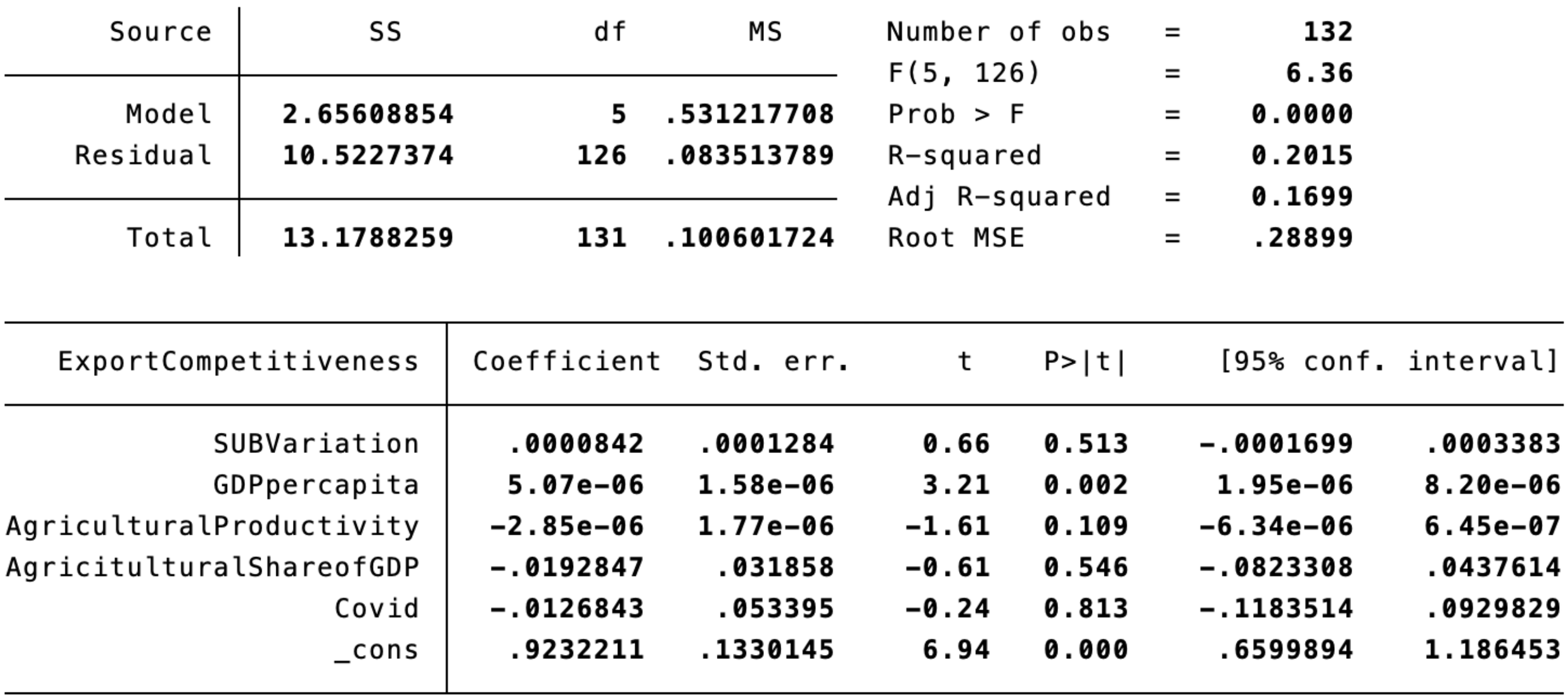
Across all specifications, subsidy variation failed to significantly predict export competitiveness. As shown in Table 3, the coefficient on SUBVariation was 0.0000842 with a p-value of 0.513, indicating no statistical relationship. The confidence interval (-0.0001699 to 0.0003383) straddled zero comfortably, reinforcing that subsidy changes did not serve as a directional driver of trade success.
In contrast, the economic scale of a country proved materially important. GDP per capita exhibited a significant, positive coefficient (5.07e-06, p = 0.002), implying that wealthier and more capital-rich member states consistently sustained stronger agricultural trade balances. The contribution of agricultural productivity, however, revealed nuance: despite the expectation that productivity gains drive global competitiveness, the coefficient was negative (-2.85e-06) and statistically insignificant (p = 0.109). This result likely reflected structural overlap with GDP per capita — confirmed when removing GDP increased the productivity coefficient but reduced overall explanatory power.
Neither agriculture’s share of GDP (p = 0.546) nor pandemic disruptions (p = 0.813) exhibited meaningful statistical influence, suggesting that neither structural sector size nor short-run shocks explained trade outcomes over this window.
The full model’s R-squared was 0.2015 (Adjusted 0.1699), indicating that ~20% of the observed variation in export competitiveness was captured by these economic fundamentals, while the remaining 80% likely depended on unobserved trade infrastructure, product sophistication, historical trade linkages, and market access dynamics.
Interpretation
The results challenged the notion that production subsidy adjustments serve as a direct strategic tool for boosting agricultural trade performance. Instead, the evidence suggested that subsidies primarily reinforce domestic market resilience, while international positioning depends more heavily on structural factors such as capital availability, logistics quality, and export-oriented value-chain specialization.
Possible mechanisms included:
Subsidies redistribute income toward stability rather than innovation.
Protected domestic demand reduces incentives to engage in globally competitive differentiation.
Inefficient producers may remain on the margin instead of reallocating resources toward export-competitive sectors.
Member states with greater economic scale already possess clear baseline advantages — regardless of subsidy changes.
Thus, subsidies may support agricultural survival without necessarily enhancing agricultural success abroad.
Policy Implications & Future Research
These findings do not dismiss the importance of CAP supports, but they underscore that competitiveness is multidimensional. To more effectively connect subsidy spending to export performance, EU policymakers may need to complement production supports with:
Innovation-linked investment subsidies
Enhanced logistics and supply-chain capability
Programs targeting product upgrading and global branding
Reduction of internal market fragmentation
Future work should extend the panel to capture long-run post-accession adjustment, incorporate sector-level disaggregation (e.g. dairy vs. cereals vs. horticulture), and employ fixed-effects models to better isolate structural differences among member states.
Conclusion
This econometric analysis offered a grounded, data-driven evaluation of a widely held assumption in EU agricultural policy. Contrary to expectations, variation in production subsidy support did not significantly improve agricultural export competitiveness across EU member states from 2018 to 2023. Instead, GDP per capita emerged as the only consistently significant predictor of superior agricultural trade performance. Productivity relationships and structural reliance on agricultural output appeared far more complex and context-dependent than subsidy rhetoric often assumes.
The overarching insight: Subsidies alone are not enough. Strengthening Europe’s agricultural export position will require policy strategies that go beyond income support and toward transformational competitive advantage.